Internet regulation

From the telephone operator to your timeline: how a 1935 law about rude phone calls became Britain's weapon against the internet

From the telephone operator to your timeline: how a 1935 law about rude phone calls became Britain’s weapon against the internet

This is chapter 1 of Regulated Without Representation, a series by internet law solicitor Yair Cohen on how Britain regulates the internet and who pays for it. New here? Start with the introduction. Picture a telephone exchange in 1935. Rows of young women in headsets, a wall of sockets and cords, and a voice in

From the telephone operator to your timeline: how a 1935 law about rude phone calls became Britain’s weapon against the internet Read More »

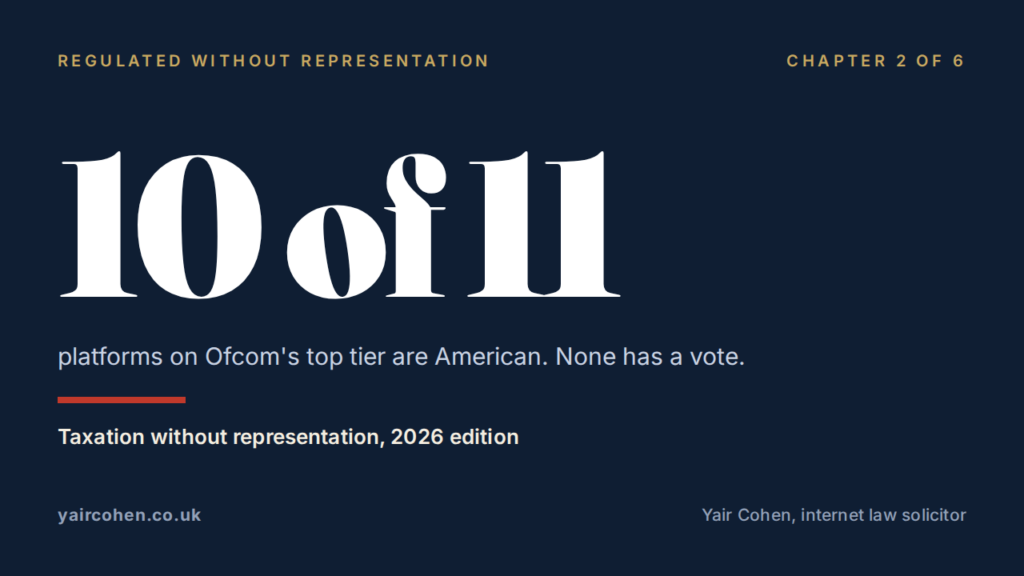
Taxation without representation, 2026 edition: Britain sends Silicon Valley the invoice for its own regulator

Taxation without representation, 2026 edition: Britain sends Silicon Valley the invoice for its own regulator

This is chapter 2 of Regulated Without Representation, a series by internet law solicitor Yair Cohen on how Britain regulates the internet and who pays for it. New here? Start with the introduction. The previous chapter is here. In the spring of 1765 the British Parliament had a problem that will sound familiar to any

Taxation without representation, 2026 edition: Britain sends Silicon Valley the invoice for its own regulator Read More »

The hamster, the judge and the regulator: 4chan v Ofcom explained

The hamster, the judge and the regulator: 4chan v Ofcom explained

This is chapter 3 of Regulated Without Representation, a series by internet law solicitor Yair Cohen on how Britain regulates the internet and who pays for it. New here? Start with the introduction. The previous chapter is here. On 14 April 2025 an email arrived at an American message board called 4chan. The sender was

The hamster, the judge and the regulator: 4chan v Ofcom explained Read More »

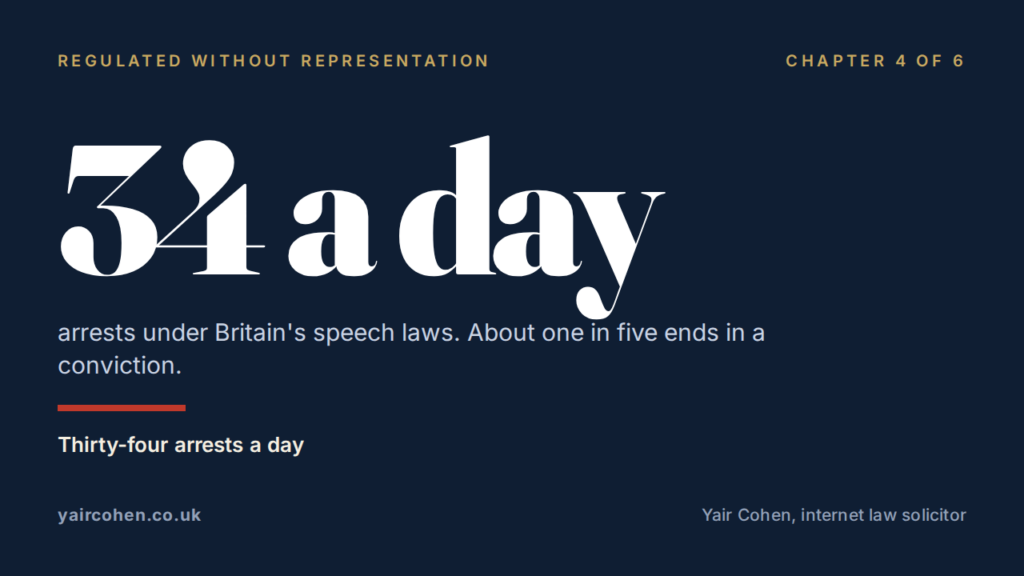
Thirty-four arrests a day: what Britain does to its own citizens for words, and the repeal it promised and forgot

Thirty-four arrests a day: what Britain does to its own citizens for words, and the repeal it promised and forgot

This is chapter 4 of Regulated Without Representation, a series by internet law solicitor Yair Cohen on how Britain regulates the internet and who pays for it. New here? Start with the introduction. The previous chapter is here. On the afternoon of 29 July 2024 a seventeen year old walked into a Taylor Swift themed

Thirty-four arrests a day: what Britain does to its own citizens for words, and the repeal it promised and forgot Read More »

Regulated Without Representation, chapter 5: Who decides what you read?

Who decides what you read? Britain’s plan to put a minister in your feed

This is chapter 5 of Regulated Without Representation, a series by internet law solicitor Yair Cohen on how Britain regulates the internet and who pays for it. New here? Start with the introduction. The previous chapter is here. Imagine the White House announced tomorrow that Google, YouTube and TikTok must put CNN and NBC at

Who decides what you read? Britain’s plan to put a minister in your feed Read More »

Regulated Without Representation, chapter 6: When the Americans say no

When the Americans say no: how the Stamp Act ended, and how this might

This is chapter 6 of Regulated Without Representation, a series by internet law solicitor Yair Cohen on how Britain regulates the internet and who pays for it. New here? Start with the introduction. The previous chapter is here. Somewhere in Whitehall, the district of London where the government departments sit, there is a spreadsheet. On

When the Americans say no: how the Stamp Act ended, and how this might Read More »

Elon Musk, UK Civil War, and Keir Starmer’s Populist Rhetoric: A Critical Analysis

Elon Musk, UK Civil War, and Keir Starmer’s Populist Rhetoric: A Critical Analysis

Recently, I was quoted in a Newsweek article discussing Elon Musk’s controversial comments regarding a potential UK civil war and Keir Starmer’s subsequent legal warnings about online violence. The full article can be read here Could Elon Musk Face Legal Action For UK ‘Civil War’ Post?. Given my deep interest in technology, law, and free

Elon Musk, UK Civil War, and Keir Starmer’s Populist Rhetoric: A Critical Analysis Read More »

The EU anti-trust case against Google-the latest chapter

Latest anti-trust ruling by the European Court Today, the European General Court upheld a 2017 anti-trust ruling by the European Commission which imposed on Google a fine of $2.8 billion following a finding of anti-competitive conduct by the internet giant Why the decision against Google is important Google has lost its appeal against a $2.8

The EU anti-trust case against Google-the latest chapter Read More »

Biden v Knight First Amendment Institute

The legal case of Biden v Knight First Amendment Institute and Twitter’s right to exclude users

Biden v Knight First Amendment Institute, summary of the facts of the case. The case was first brought on behalf of Twitter users who objected to the right of President Donald Trump to block them. The core complaint was that the President’s Twitter account was an “official” account and that the comments section on his Twitter account was a “constitutionally protected public forum

The legal case of Biden v Knight First Amendment Institute and Twitter’s right to exclude users Read More »

Tracking COVID cases with mobile technology and privacy rights

Why European governments are reluctant to use mobile phone tracking apps during COVID19

Tracing apps are playing a significant role in some countries in combating COVID-19. There is no doubt that COVID-19 has given a huge boost to some technological advances but more importantly, the virus has created a public readiness to accept them.

Why European governments are reluctant to use mobile phone tracking apps during COVID19 Read More »

Solicitor Yair Cohen

Twitter, Facebook, Political Ads, Fake News and Mission Statements

At times of trouble, when important decisions need to be made, within the organisation about a critical topic, the place to turn to for the right answer is the mission statement. Mission statements are a way get everyone focused on the right direction, and they play a part in helping a business make sound long-term decisions.

Twitter, Facebook, Political Ads, Fake News and Mission Statements Read More »

Social media accountability for hate speech

Should social media platforms be made accountable for hate speech?

Social media platforms to be accountable for amplifying hate speech from Yair Cohen Solicitor on Vimeo. 8chan is where the suspect of the El Paso Shooting is believed to have posted a white nationalist manifesto rant. The platform in the meantime, had been shut down but the post was then copied to numerous mainstream social

Should social media platforms be made accountable for hate speech? Read More »

Facebook launches ads scam report tool following defamation lawsuit

It’s an industry wide problem but will the big tech giants ever understand the reach of the damage that their negligent behaviour can cause? Facebook has created a reporting tool for scam adverts and donated £3m to Citizens Advice for an anti-scan project called Scams Action. The project was launched by Facebook after they agreed to

Facebook launches ads scam report tool following defamation lawsuit Read More »

Perhaps Facebook does not really want content on its platform to be moderated

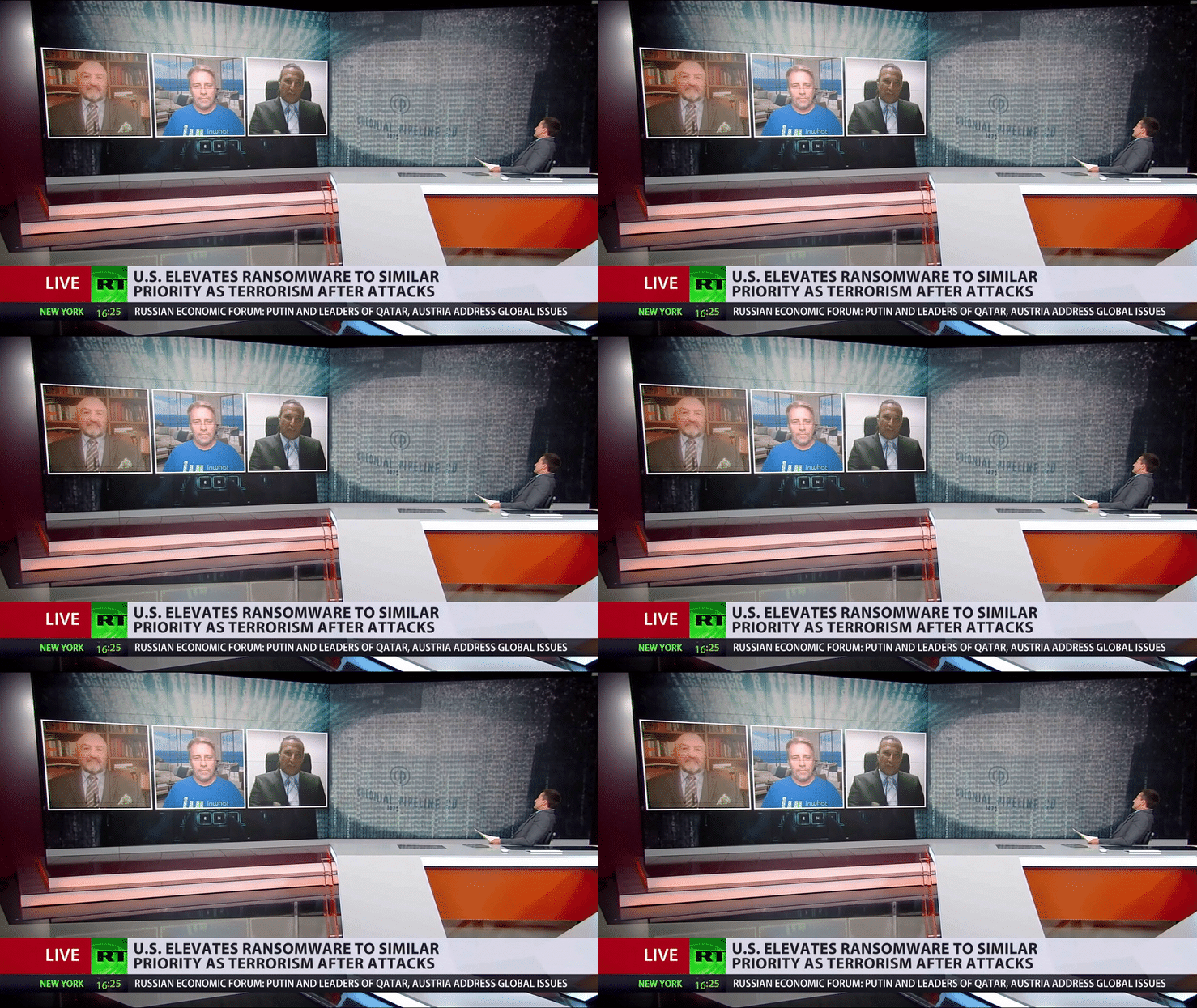
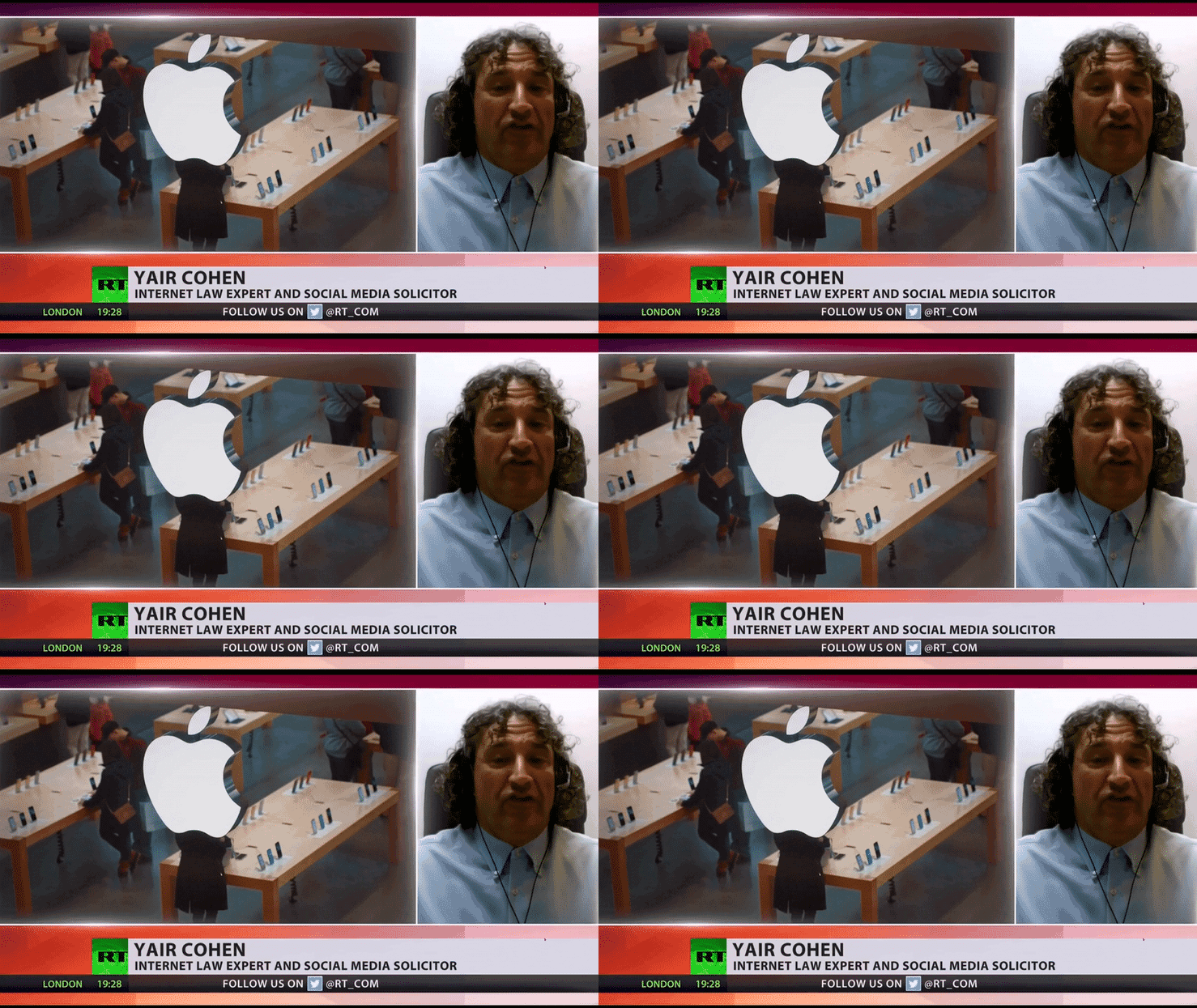
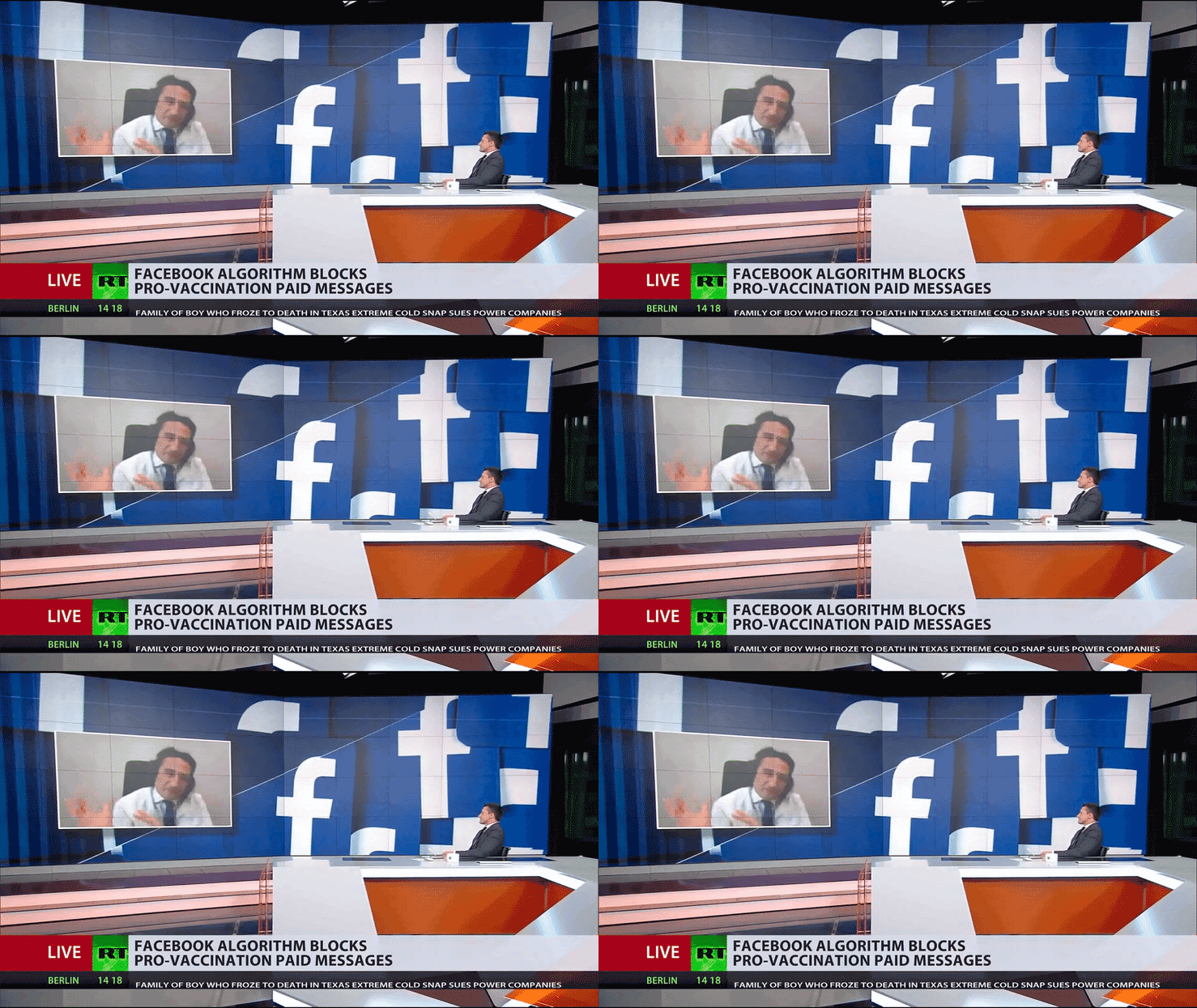
In an interview with RT News, Yair Cohen – Internet Law and Social Media Lawyer, discusses alongside Bill Merr, a privacy campaigner, the recent revelation about Facebook’s moderator contractors’ poor working conditions and what Facebook could possibly do to improve working conditions.

Perhaps Facebook does not really want content on its platform to be moderated Read More »

What the US Government is hoping to achieve with the Antitrust Probe

US Congress launches Big Tech Antitrust Probe The federal government is warming up its antitrust enforcement machine and is likely to be in the first stages of a ‘top-to-bottom review of the market power’ and is pointing it at the giant tech platforms – Facebook, Amazon, Google and Apple. The anti-trust probe has been initiated

What the US Government is hoping to achieve with the Antitrust Probe Read More »

Why regulating social media companies could prevent self harm and suicide among young children

Should social media companies face regulation to help prevent self-harm and suicide among children

In the UK, there are no specific laws to shield social media companies from being held accountable for the material which is published on their platforms. The courts, however, have largely allowed them to get away with claims that they are not “publishers” but only provide

Should social media companies face regulation to help prevent self-harm and suicide among children Read More »

Why does Facebook ban right-wing extremists

The government will eventually, like it or not, police the internet. This is inevitable. The recently published White Paper which warned internet companies very clearly of its intention to set up a new internet regulator is an indication of what social media companies should expect to see in the future. How powerful this regulator will be, will largely depend on how genuine social media companies’ effort to combat intolerance, prevent self-harm and decrease the amount of fake news is.

Why does Facebook ban right-wing extremists Read More »

Protecting children’s safety on the internet

Who is responsible for protecting children’s safety online

Internet police author Yair Cohen says I am often asked, how much of a responsibility do we as internet users have, to police the internet ourselves and decide whether we are going to watch certain images or share horror films of live events. After all, the more we share the more we encourage others to commit social media atrocities.
This is a very interesting question. It is easy to blame us, the people, for our part in watching and sharing horrific images via social media. At the same time, people should not be judged too harshly in this regard because after all, we are only human. When we see something that is shocking, something t

Who is responsible for protecting children’s safety online Read More »

Freedom of Speech and Online Harassment

The reason why some people allow themselves to say online what they wouldn’t dare saying in person goes back to the early days of the internet, where there was a perception that the internet was outside the scope of regulations and policing. It was a free space where people could do whatever they wanted; free speech was king, there wasn’t a government and in fact,

Freedom of Speech and Online Harassment Read More »

Why this year might have signalled the beginning of the end for Facebook’s business model

Internet lawyer Yair Cohen said that Facebook relies on its hugely complicated, ever changing terms and conditions, which it knows nobody reads. Consent needs to be of clear and coherent and informed and anyone who ever tried to look at any of Facebook’s terms and conditions or tried to change the settings of Facebook privacy settings will know that its terms and conditions are anything but coherent and clear.

Why this year might have signalled the beginning of the end for Facebook’s business model Read More »

Why tech and social media companies should face stricter regulation and pay more tax

Yair Cohen, a partner at Cohen Davis Solicitors, discusses the pros and cons of self-regulation and considers why the current taxation system is unfair. To understand the reasons behind the need to end the special treatment tech and social media companies receive by the UK and other Western governments, both, in terms of general regulations

Why tech and social media companies should face stricter regulation and pay more tax Read More »
Internet police in action: Yahoo scanned emails to help FBI.

The FBI has stepped up its effort to police the internet by requesting Yahoo to assist in developing software to scan emails which were going through YahooMail servers. Yahoo was reported to have agreed but the intrusion did not only affect YahooMail customers but also other email users who happened to communicate with a YahooMail

Internet police in action: Yahoo scanned emails to help FBI. Read More »

The $1 billion lawsuit against Facebook over Hamas incitement: what happened to it

Lawsuit against Facebook . Radio interview with Yair Cohen, UK social media litigation lawyer. Facebook sued by Israeli and USA citizens over Palestinian attacks. Lawyers have filed a $1B lawsuit against Facebook, accusing it of knowingly supporting the Palestinian group Hamas. Law suit against Facebook might succeed. Facebook harassment legal advice

The $1 billion lawsuit against Facebook over Hamas incitement: what happened to it Read More »
The Model Law Commission: the internet laws young people asked Parliament for

In 2013 I was privileged to be invited to the Supreme Court to take part in the Model Law Commission, a project run by Big Voice London with the support of the Supreme Court and the Law Commission, in which a group of sixth-form students from London state schools are encouraged to design law reforms

The Model Law Commission: the internet laws young people asked Parliament for Read More »

Scroll to Top