

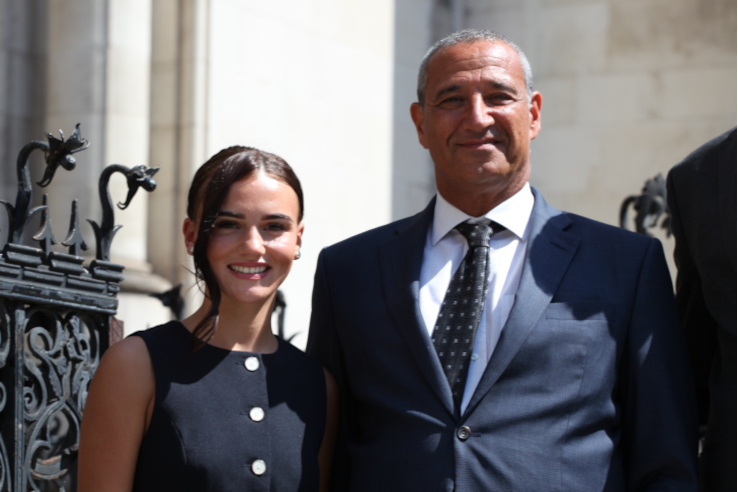
When the producer of ITV’s This Morning called me on the eve of a rainy March day and asked whether I would come on the show to comment on the phenomenon of catfishing, I thought nothing of it. After nearly three decades in internet law, television interviews about online deception have become part of the furniture of my working life. I expected to explain, as I have done many times before, what catfishing is, why victims are so often told that nothing can be done, and why that answer is almost always wrong. I did not expect the case that would follow me home from the studio.
The girl in the studio
The first time I met Sasha Davies was in the studio itself. She was there to tell her own story, and I listened to it alongside the rest of the country. It had started when she was 16 years old, still at school. Accounts began appearing across the internet using her photographs under another name, most prominently “Sophie Kadare”. Over nearly four years, the fake “Sophie” spread across seven platforms, and more than 100,000 people ended up following a girl who did not exist, wearing the face of a girl who did.
Then the fake life began to invade the real one. Strange men approached Sasha in the street, in Cardiff and in Swansea, and insinuated that they had been in a relationship with her. One man showed her his phone, with months of intimate messages he believed he had been exchanging with her. Imagine being 17, 18, 19 years old and not knowing, every time you leave your front door, whether the next stranger who smiles at you believes you have been his girlfriend for months. Sasha stopped feeling safe leaving her own house. She reported it to the platforms and to the police, again and again, and for four years the answer was the same: whoever was doing this was anonymous, and without a name, there was nothing anyone could do.
Two questions from Ben Shephard
At the end of the interview, Ben Shephard turned to me and asked, “Mr Cohen, would you help Sasha?” I did not think twice. “Yes, of course.” Then came the second question: would I actually be able to trace her harasser? I told him, and by extension the nation, that I always do.
Football fans will remember Ange Postecoglou announcing, in his first season at Tottenham, that he always wins a trophy in his second season. He said it because it happens. And then, with the whole country waiting for him to fall on his face, he delivered one. As the words left my mouth on live television, I understood the stretch of the statement I had just made in front of the nation. Ange had delivered his trophy. Now I had to deliver mine, and I had to deliver it where the police had failed for nearly four years.
So I did not waste time. The moment the cameras stopped rolling, I went over and, for the first time, spoke with Sasha properly and introduced myself. That short conversation, after the show rather than on it, was the real beginning of the case. What followed was a hunt that took my team just 48 hours, and a legal battle that took several months.
The hunt
The person behind “Sophie” had been watching all along. Within minutes of the initial BBC report, most of the fake accounts were deleted. Then, shortly after the This Morning broadcast, the last remaining traces were gone. Forever, she must have believed. But here is something these cases have taught me: online trolls always leave something behind. You cannot completely erase four years of life across dozens of online accounts. There will always be something left for the detective to find.
And this is where I turned to the detectives inside my own law firm. Aytan, who trained with me in open-source investigations, went to work on what was left of “Sophie”. A music account connected to her network of profiles turned out to be registered in a real name. Small personal details that “Sophie” had shared with her followers over the years matched the real circumstances of the same person. Piece by piece, the trail led to one individual, and, as in so many of my catfishing cases, not to a distant stranger, but to another young woman from the same part of Wales. It took the team 48 hours to find her.
Finding her, however, was one thing. Concluding the matter was quite another. Elha was not going to surrender Sasha’s identity so quickly, and it took several months of persistent legal work before we were able to bring the case to an end. This is where my colleague Reagan Brien came in, the solicitor who carried out much of the legal work that followed. On 13 July 2026, before a judge of the Media and Communications List at the High Court in London, an agreed statement was read in open court. It named Elha Mai Weston as the person behind the four-year impersonation. She accepted that her conduct was wrongful, apologised to Sasha wholeheartedly and unreservedly, agreed to pay her £10,000 in compensation, and gave promises directly to the court, on pain of imprisonment, never to contact Sasha, never to impersonate her, never to monitor her online life, and to delete every photograph and every message relating to her. The promise made on the This Morning sofa had been kept, and this week Sasha and I returned to the same sofa to tell the country how it ended.
What the cameras did not show: Sasha’s courage
Much has already been written about this case, the fake accounts, the followers, the High Court. What has not been written about enough is Sasha herself, and hers is the part of the story I most want people to read.
This was a girl who was targeted at 16 and tormented for nearly four years, through the exact years in which a young person is supposed to be building her confidence, her friendships and her place in the world. The catfish took her face, her name and her sense of safety, and what that does to a person mentally is not something you shake off at the end of a school day. She could not leave the house without fearing the next stranger. And yet, somehow, Sasha carried on. She kept studying, and did well. She kept her warmth. The young woman I met in that studio, at 19, after everything, was one of the most intelligent, sensitive and helpful people I have come across in my career, and she remained exactly that through every difficult month of the case. That is not luck. That is courage of a very quiet, very rare kind.
The catfish hunter
After Kirat Assi’s Sweet Bobby case, after Sasha’s case, and after a number of others that I will never be able to talk about, for the sake of my clients’ privacy, I am now considered by some to be a bit of a catfish hunter. I take the label with a smile, but underneath it sits a serious point: catfish get caught. The turning point in these cases is never a new law. It is identification. The moment we put a real name to “Sophie”, everything the law can offer became available to Sasha at once. That is why I could answer Ben Shephard’s second question without flinching. Finding them is not luck. It is method, patience and experience, and it works far more often than victims are led to believe.
To every victim reading this
If you are being catfished or impersonated, there are two things I want you to hold on to, because they are the two things that got Sasha through.
The first is your mental balance. A catfishing campaign is designed, whether its author admits it or not, to occupy your mind, your relationships and your freedom. Protect them deliberately. Sasha never allowed the catfish to completely destroy her freedom, or the good she sees in people. That mattered as much to her recovery as anything we did in court.
The second is the pursuit of their identity. Do not accept “nothing can be done”, because that almost always means nothing can be done while the person is anonymous, and anonymity is a solvable problem. Sasha did not have the funds for litigation when this began, but she never lost hope, and she pursued the person behind “Sophie” until that person stood named in a courtroom. And here is a thought worth keeping close: a person who spends four years living behind your face is, in the end, likely to be far more damaged than you are. The shame in these cases belongs to one person only, and it is never the victim.
Final thoughts
I am grateful that I am able to help people like Sasha. Clients who come to me with stories like hers tend not to pass through my life and out of it; like many of them, I am sure Sasha and I will remain in contact for years to come. The full legal account of the case, including how the court order works and the questions victims most often ask, is on my firm’s website: the Sasha Davies catfishing case: a High Court apology and damages after a four-year impersonation.
And if you or someone you know is being catfished right now, do not accept that nothing can be done. No matter how unbelievable your story may seem, it deserves to be heard, and there is a path to justice.