

This is chapter 6 of Regulated Without Representation, a series by internet law solicitor Yair Cohen on how Britain regulates the internet and who pays for it. New here? Start with the introduction. The previous chapter is here.
Somewhere in Whitehall, the district of London where the government departments sit, there is a spreadsheet. On the credit side it shows the Digital Services Tax, which brought in £944 million last year, and the online safety fee, which will cover Ofcom’s roughly £70 million a year of online safety costs and is intended, from next year, to start repaying the set-up bill as well. Most of it, on any reasonable estimate, is paid by American companies, and none of them can vote. From the Treasury’s side of the desk that may well look like the closest thing to free money a government ever sees.
I have spent five chapters describing the machine. This one is about the debit column, which I do not think anyone has filled in.
What Washington has done, in order
The pattern matters more than any single entry, so let me give you the chronicle.
February 2025. The Vice President stands up at the Munich Security Conference, an annual gathering of the transatlantic defence establishment, and tells the room that in Britain “free speech, I fear, is in retreat“. A week later the President signs a memorandum with the unsubtle title “Defending American Companies and Innovators From Overseas Extortion and Unfair Fines and Penalties”. It names the United Kingdom.
May 2025. The Secretary of State, Marco Rubio, announces a visa policy for “foreign nationals who are responsible for censorship of protected expression in the United States”, declaring it “unacceptable for foreign officials to demand that American tech platforms adopt global content moderation policies or engage in censorship activity that reaches beyond their authority and into the United States”.
July 2025. The chairman of the House Judiciary Committee leads a delegation to London and meets Ofcom’s chief executive and two cabinet ministers.
August 2025. The State Department’s annual human rights report says the situation in Britain has “worsened”, cites “credible reports of serious restrictions on freedom of expression”, and notes that the Online Safety Act “expressly expanded Ofcom’s authority to include American media and technology firms with a substantial number of British users, regardless of whether they had a corporate presence in the UK”.
September 2025 and February 2026. Two congressional hearings under the title “Europe’s Threat to American Speech and Innovation”, both naming the Act. Nigel Farage testifies at the first. At the second, the star witness is the man who co-wrote Father Ted, describing his arrest at Heathrow.
December 2025. The visa policy is used. Five Europeans are placed under restrictions, two of them Britons, the heads of the Center for Countering Digital Hate and the UK-based Global Disinformation Index. The State Department “stands ready and willing to expand today’s list”.
January 2026. According to reports, the State Department launches freedom.gov, a portal offering people in Britain and Europe tools to get around their governments’ online restrictions. Pause on that one. The United States Government, by all accounts, built a website to help British citizens evade British law.
April to September 2026. The bills. The No Censors on our Shores Act, which would make foreign officials who censor Americans inadmissible to the United States, is reported out of committee. The GRANITE Act would bar American courts from enforcing foreign online speech judgments and fines. The HOMEFRONT Act, introduced on 8 September, would do the same and, in its sponsor’s words, “grant Americans a private right of action to sue foreign governments in U.S. courts”, bar American agencies from cooperating with foreign regulators, and prohibit extradition for foreign speech offences. None has passed either chamber. All of them are aimed, in part, at Britain.
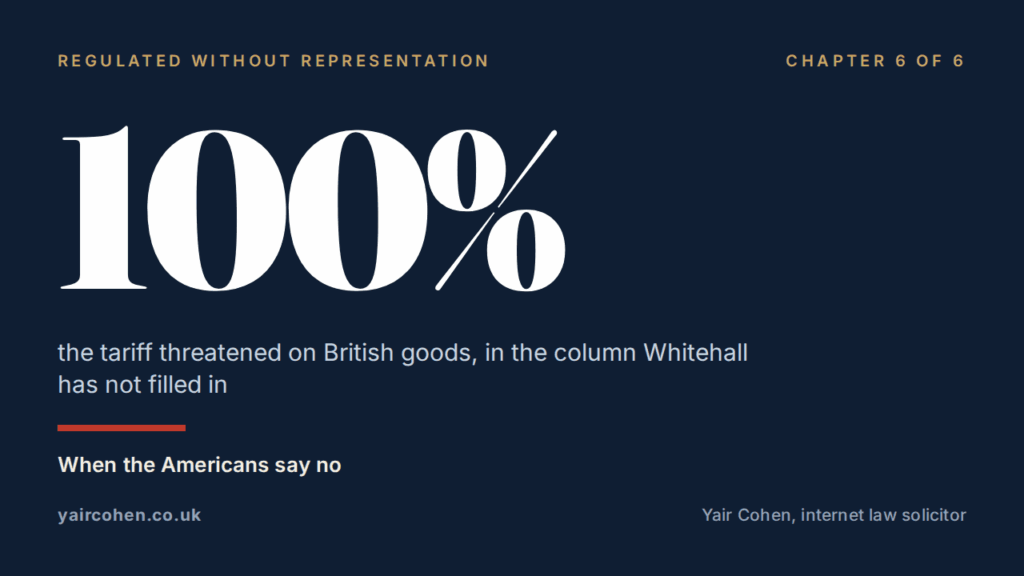
June to September 2026. The money. The President announces that “any Country that imposes such a Tax will immediately be met with a 100% TARIFF on any and all Goods sent to the United States of America”. The Trade Representative says in August that this is “not a bluff” and accuses Britain of treating American companies as “piggy banks”. The British Government replies that the tax is “an interim measure” and that it remains “open to discussing U.S. concerns”. The $42 billion “Tech Prosperity Deal” signed during the President’s state visit has been frozen since December 2025 over the tax and, reportedly, Britain’s online safety rules. Andy Burnham, Prime Minister since July, meets the President for the first time in New York on 22 September; no announcement on the tax follows. And on 2 September, as we saw in chapter 5, the United States formally asks Britain to withdraw its news prominence plan.
What has moved, and what has not
A fair scorecard.
When the issue was the encryption of Americans’ data, Washington got a result in months. In January 2025 the Home Office, Britain’s interior ministry, ordered Apple to build a way into encrypted iCloud backups worldwide. Apple withdrew its strongest encryption from British customers rather than comply. In August 2025 the American Director of National Intelligence announced that Britain had “agreed to drop its mandate” as regards Americans’ data. The Home Office has never publicly confirmed this. Britain then served a second order confined to British users, which Apple is fighting in the Investigatory Powers Tribunal, a specialist court that hears much of its business in closed session. British Apple users still cannot switch on the protection Americans have. Non-crime hate incidents were abolished two months after the second congressional hearing. The Government is, in its own words, “open to discussing” the tax. When the issue was Google’s dominance of search, Britain’s competition regulator imposed rules in June 2026 letting publishers keep their content out of Google’s AI answers without losing their ranking, which Google has nine months to put in place.
When the issue was speech, nothing statutory has moved. The Online Safety Act is on schedule. The 1935 offence is intact. The prominence plan went to consultation, drew a letter from the chairman of the House Judiciary Committee within three weeks, and was still being defended in Westminster Hall a week after the United States asked for it to be withdrawn. Ofcom’s chief executive described being sued in Washington as a sign of success. Both governments, it seems to me, have voters who reward not backing down.
The debit column
Here is what I think belongs on the other side of the spreadsheet.
Tariffs. The United States takes about 15 per cent of all British goods exports. A 100 per cent tariff on all of it, set against £944 million of tax and £70 million of fees, is not a trade the Treasury would knowingly make. The threat may be a bluff. The Trade Representative says it is not. The point is that the tax and the fee are only “free” if the payer’s government does nothing, and that government has said, repeatedly and in writing, that it intends to do something.
Sanctions on people. Two British citizens have already been placed under United States visa restrictions for what the State Department calls censorship. Nobody at Ofcom has been named. But the No Censors on our Shores Act is drafted to cover foreign officials, and the State Department has said it will expand its list. The prospect of British regulators unable to attend a conference in San Francisco is no longer fanciful. I hope it does not happen. I note that no one in London appears to have planned for it.
Unenforceability. After the Washington judgment of 15 September, an American company cannot, on that ruling, use an American court to attack Ofcom’s enforcement. But the same judgment said, in terms, that American courts “are not necessarily required to enforce foreign penal judgments“, and GRANITE or HOMEFRONT would make that a statutory rule. Ofcom has already told Parliament that most of the £7 million it has imposed has not been paid. A regime whose fines cannot be collected abroad rests entirely on the willingness of the large platforms to comply at home. That willingness is a commercial decision, and it is being made in boardrooms that also read the White House memoranda.
Exit. About 70 services have already left or blocked Britain. They are small, and the Government has shrugged. But the world’s largest social media company lodged an appeal against the top tier designation of WhatsApp and Instagram on 22 September, and the Wikimedia Foundation has been to the High Court once and Wikipedia is reported to remain on Ofcom’s watch list. I do not predict that Instagram will switch Britain off. I do say that if any large service ever decided that Britain was not worth the fee, the fine, the back bill and the algorithm rules, the loss would fall on British users and the British small businesses that trade on those platforms, and that nobody has estimated it. Ofcom has already conceded that it could not seek to block a suicide forum it wanted gone. A regulator that cannot keep a bad site out may find it has helped good ones leave.
Reputation. This is the softest entry and the one I mind most. Britain now appears in the United States’ annual human rights report for restrictions on speech. Britain’s closest ally is reported to run a website to help Britons get around British law. Half a million Britons signed a petition to repeal the Act, and the Government’s answer was that it had no plans to. None of this is on the spreadsheet either.
How the Stamp Act ended
The Stamp Act was not repealed because Parliament was persuaded by the colonists. It was repealed because the colonists stopped buying British goods, and British merchants, who did have votes, complained loudly enough to be heard. The lesson is not that pressure from abroad works. It is that pressure from abroad works when it creates pressure at home.
The equivalent today is not Meta. It is the British advertiser whose customers vanish when a platform withdraws, the British creator whose channel is pushed below the fold, the British user who reaches for a VPN to use a site that has blocked the country, and the British Jew told by statute which news outlet to trust. The time will come, and I think it is closer than Whitehall believes, when the American companies either shout loudly enough to be heard or quietly leave, and when that happens the people who will feel it are British. I would rather we fixed this before then.
The next twelve months
For readers who like to know what to watch, here is the calendar as it stood in September 2026, when this chapter was written.
- 2 October 2026. Ofcom’s consultations on the extra duties for Category 1 platforms and on fraudulent advertising close; the final rulebook for the top tier is expected in 2027.
- Autumn 2026. The Government’s response to Watch this Space: a voluntary deal, legislation, or both.
- By mid-October 2026. Whether 4chan appeals the Washington ruling.
- Any time. Ofcom’s decision on X over Grok, which would be the first fine against a Category 1 platform, and the first time Ofcom asks a court for a business disruption order. Neither has happened yet.
- December 2026. Regulations for the under-16 social media ban, announced in June and due in force in spring 2027, with Ofcom enforcing.
- Ongoing. The tax negotiation, the tariff threat, the frozen Tech Prosperity Deal, and whether GRANITE, HOMEFRONT or No Censors on our Shores reaches a floor vote.
My final thoughts
None of what follows requires Britain to abandon child protection or give the platforms a free pass. It requires Britain to build a regime that its allies can live with and its own citizens can understand.
Pay for the regulator ourselves. Fund Ofcom’s online safety work from the Exchequer, the national treasury, so that Parliament votes the budget every year and answers for it. If the fee must stay, cap it, charge it on British revenue only, and drop the back bill. A regulator whose income rises with its own ambition is not a regulator anyone should want.
Narrow the Act to what it is for. Illegal content and children’s safety, with a real exemption for small and low-risk services. A law that catches 100,000 services, many of them abroad, cannot be enforced across the board, and the regulator has now told Parliament how hard it is finding the task.
Keep the 2022 promise. Repeal section 127(1) of the Communications Act and the “grossly offensive” limb of the Malicious Communications Act, and enact the harm-based offence the Law Commission designed, as the Government said it would. Threats, harassment and stirring up hatred have their own laws. Being offensive should not be a crime.
Drop mandatory prominence. If the Government wants people to see trusted news, let them choose it, opt in, with the ranking rules published. The state should not certify journalism, and it should not create a class of outlets that owe their audience to a minister.
Use the treaties. Serve foreign companies through the Hague Service Convention and the other channels that exist for the purpose, and open a proper conversation with Washington about a shared framework for platform regulation, including how each side will treat the other’s judgments. Unilateral reach invites unilateral response, and we are now receiving it.
Publish the numbers. Speech arrests by force and offence. Fines imposed and fines paid. Services in scope and services that have left. A government that will not count what it is doing should not be surprised when others count for it.
Dear Britain
I began this series with a letter to America. Let me end with one to my own country.
We have a long and decent tradition on speech. The Lord Chief Justice wrote in 2012 that satire, rudeness and unpopular opinion “should and no doubt will continue at their customary level, quite undiminished” by our communications laws. We ended the licensing of the press in 1695. We do not need to be lectured about freedom by anyone, and we do not need to relearn it from them either. We only need to notice what we have built, add up what it costs, and remember that the last time we sent America a bill for its own policing, it did not end with a cheque.
If you are a journalist and any of this is new to you, every chapter has its sources at the foot. If you are an American lawyer with a client in Britain’s sights, my door in Soho is open. And if you are a British reader who got this far: write to your Member of Parliament, and ask one question. Who is going to pay for this, when the Americans stop?
Yair Cohen
For the serious reader
If you are a US company: the months ahead contain the Government’s response on prominence, the first fee invoices, any 4chan appeal, the outcome of the Category 1 codes consultation, and the tariff negotiation. Engage now, while “voluntary agreement” is still the language being used. What you agree to voluntarily is what the legislation will later require.
If you are British: the services you use, the news you are shown and the words you can post are all being decided in documents very few people have read. This series is an attempt to change that. Share it.
If you are a journalist: the numbers in this series that no official body publishes are the arrests, the fines actually paid, and the services that have left. Ask for them.
Series index: Introduction: Dear America, Ofcom has sent you a bill | Chapter 1: From the telephone operator to your timeline | Chapter 2: Taxation without representation, 2026 edition | Chapter 3: The hamster, the judge and the regulator | Chapter 4: Thirty-four arrests a day | Chapter 5: Who decides what you read? | Chapter 6: When the Americans say no
Sources for this chapter
- HMRC, Tax and NICs receipts (Digital Services Tax), August 2026: https://assets.publishing.service.gov.uk/media/6a82f19d3be22055c1aaa3ba/NS_Table.ods
- Ofcom Annual Report and Accounts 2025/26: https://assets.publishing.service.gov.uk/media/6a4e92bb43f694ee291df854/Ofcom_Annual_Report_and_Accounts_2025-2026_optimised_A.pdf
- Vance, Munich Security Conference transcript, 14 February 2025: https://rollcall.com/factbase/trump/transcript/donald-trump-remarks-jd-vance-munich-germany-munich-security-conference-february-14-2025/
- White House memorandum, 21 February 2025: https://www.whitehouse.gov/presidential-actions/2025/02/defending-american-companies-and-innovators-from-overseas-extortion-and-unfair-fines-and-penalties/
- State Department, visa restriction policy, 28 May 2025: https://www.state.gov/announcement-of-a-visa-restriction-policy-targeting-foreign-nationals-who-censor-americans/
- State Department, actions to combat the global censorship-industrial complex, 23 December 2025: https://www.state.gov/releases/2025/12/announcement-of-actions-to-combat-the-global-censorship-industrial-complex
- Al Jazeera, US bars five Europeans, 24 December 2025: https://aljazeera.com/news/2025/12/24/us-bars-five-europeans-over-efforts-to-censor-american-viewpoints
- State Department, 2024 Country Report on Human Rights Practices, United Kingdom: https://www.state.gov/reports/2024-country-reports-on-human-rights-practices/united-kingdom/
- House Judiciary Committee hearing, 3 September 2025: https://judiciary.house.gov/committee-activity/hearings/europes-threat-american-speech-and-innovation
- House Judiciary Committee hearing, 4 February 2026: https://judiciary.house.gov/committee-activity/hearings/europes-threat-american-speech-and-innovation-part-ii
- Free Speech Union, US launches freedom.gov, January 2026 (secondary source): https://freespeechunion.org/news/us-launches-free-speech-portal-to-help-uk-and-eu-citizens-bypass-onlin
- H.R. 1071, No Censors on our Shores Act, bill status: https://www.govinfo.gov/bulkdata/BILLSTATUS/119/hr/BILLSTATUS-119hr1071.xml
- H.R. 10174, GRANITE Act, bill status: https://www.govinfo.gov/bulkdata/BILLSTATUS/119/hr/BILLSTATUS-119hr10174.xml
- H.R. 10309, HOMEFRONT Act of 2026, bill status: https://www.govinfo.gov/bulkdata/BILLSTATUS/119/hr/BILLSTATUS-119hr10309.xml
- Rep. Warren Davidson, HOMEFRONT Act press release, 8 September 2026: https://davidson.house.gov/press-releases?ID=DFB66BDB-2472-4A75-9400-F9E9807EAA39
- CBS News, Trump 100 per cent tariff threat, 26 June 2026: https://www.cbsnews.com/news/trump-digital-services-tax-tariff-europe/
- Time, UK responds to Trump pressure over DST, 19 August 2026: https://time.com/article/2026/08/19/uk-responds-to-mounting-trump-pressure-over-digital-services-tax/
- The Register, US halts UK tech deal, 16 December 2025: https://www.theregister.com/2025/12/16/us_uk_trade_deal/
- Euronews, Burnham meets Trump, 22 September 2026: https://www.euronews.com/2026/09/22/burnham-touts-good-connection-with-trump-as-pair-meet-for-first-time-in-new-york
- The Register, UK Apple backdoor U-turn, 19 August 2025: https://www.theregister.com/2025/08/19/uk_apple_backdoor_uturn/
- Privacy International, Apple TCN challenge timeline: https://privacyinternational.org/legal-action/pi-apple-tcn-challenge
- CMA, fairer deal for publishers and Google search, 3 June 2026: https://www.gov.uk/government/news/cma-secures-fairer-deal-for-publishers-and-improves-google-search-services-in-uk
- ONS, UK trade with the United States, 1 May 2026: https://www.ons.gov.uk/economy/nationalaccounts/balanceofpayments/articles/uktradewiththeunitedstates/exportsandimportsofgoodsfollowingtheintroductionofustariffsapril2025tofebruary2026
- 4chan v Ofcom, memorandum opinion, 15 September 2026: https://www.govinfo.gov/content/pkg/USCOURTS-dcd-1_25-cv-02880/pdf/USCOURTS-dcd-1_25-cv-02880-0.pdf
- Lords Communications and Digital Committee, oral evidence, 15 September 2026: https://committees.parliament.uk/oralevidence/18091/pdf/
- Open Rights Group, Online Safety Act shutdowns and site blocks: https://www.blocked.org.uk/osa-blocks
- Silicon UK, Meta appeals Category 1 designation, 22 September 2026: https://www.silicon.co.uk/e-regulation/legal/meta-ofcom-legal-631659
- Ofcom, online suicide forum investigation and review of enforcement powers, 20 July 2026: https://www.ofcom.org.uk/online-safety/illegal-and-harmful-content/online-suicide-forum-investigation-and-review-of-enforcement-powers
- Petition 722903, Repeal the Online Safety Act: https://petition.parliament.uk/petitions/722903?reveal_response=yes
- UK Parliament, The Stamp Act and the American colonies 1763 to 1767: https://www.parliament.uk/about/living-heritage/evolutionofparliament/legislativescrutiny/parliament-and-empire/parliament-and-the-american-colonies-before-1765/the-stamp-act-and-the-american-colonies-1763-67/
- Gov.uk, social media to be banned for under-16s, 15 June 2026: https://www.gov.uk/government/news/social-media-to-be-banned-for-under-16s-in-landmark-government-move-to-givekids-their-childhood-back
- Written Ministerial Statement HCWS590, 4 February 2022: https://questions-statements.parliament.uk/written-statements/detail/2022-02-04/hcws590
- Chambers v DPP [2012] EWHC 2157 (Admin): https://www.judiciary.uk/wp-content/uploads/JCO/Documents/Judgments/chambers-v-dpp.pdf