

This is chapter 4 of Regulated Without Representation, a series by internet law solicitor Yair Cohen on how Britain regulates the internet and who pays for it. New here? Start with the introduction. The previous chapter is here.
On the afternoon of 29 July 2024 a seventeen year old walked into a Taylor Swift themed dance class in Southport, a seaside town near Liverpool, and killed three little girls. Within hours, false claims were circulating online that the attacker was a Muslim asylum seeker who had arrived by boat. He was neither; he had been born in Wales. It made no difference. Over the next ten days there were riots in towns and cities across the country. Mosques were attacked. Hotels housing asylum seekers were attacked. Police officers were hurt.
That same evening, in Northampton, a childminder called Lucy Connolly posted a tweet. It called for mass deportation and for the hotels to be set on fire, “for all I care”. She deleted it within about four hours. By then it had been viewed some 310,000 times.
I want to be clear about what she wrote. It was vile. If someone had acted on it, people could have died. I am not going to argue that it was harmless, or that the law should have looked the other way. What I am going to do is set what happened to her beside what happened to the people who actually rioted, because that comparison is why her name is now in every American government statement about Britain.
The courts sit through August
The Government’s answer to the riots was speed. Courts sat through the summer holiday. People were charged within hours and sentenced within days. A year on, the National Police Chiefs’ Council reported 1,876 arrests, 1,110 charges and a conviction rate of 96 per cent. Of those sentenced by August 2025, the average term was 26 months.
Keir Starmer, then Prime Minister, set the tone on 9 August 2024, the day the first online posters were jailed: “whether you’re directly involved or whether you’re remotely involved, you’re culpable”. Remotely involved meant people who had posted rather than marched. Sir Mark Rowley, the Metropolitan Police Commissioner, who heads London’s police, was asked about people posting from abroad and said: “whether you’re in this country committing crimes on the streets or committing crimes from further afield online, we will come after you.” American cable news ran it as a threat to extradite Americans. No American has been extradited. But the sentence was noticed in Washington, and it has been quoted there ever since.
Now the chart. Tyler Kay, 26, who posted on X urging people to set fire to hotels housing asylum seekers: 38 months. Wayne O’Rourke, 35, who ran an X account with about 98,000 followers: three years. Jordan Parlour, 28, for Facebook posts about a hotel in Leeds: 20 months. Julie Sweeney, 53, for a Facebook comment saying “blow the mosque up with the adults in it”: 15 months, reported to be the first prison sentence under the new Online Safety Act offence of threatening communications. And Lucy Connolly: 31 months.
Nobody on that chart threw a brick. Compare their sentences to the 26 month average for people who did. All five pleaded guilty, four of them within days. No jury ever looked at the posts.
What happened to Lucy Connolly
Connolly was arrested at home on 6 August 2024 and held in custody. In September she pleaded guilty to publishing material intended to stir up racial hatred, an offence under section 19 of the Public Order Act 1986 that carries seven years, and in October she was sentenced to 31 months. She applied to appeal. In May 2025 the Court of Appeal refused, rejecting her argument that she had not understood the basis of her guilty plea. In August 2025 she was released after about twelve and a half months, under the early release rules Britain adopted because its prisons were full.
By then she was famous on the other side of the Atlantic. The State Department said it was “monitoring” her case and named her in its annual human rights report on Britain, which found “credible reports of serious restrictions on freedom of expression”. One deleted tweet, no violence, a guilty plea, and a sentence longer than many of the rioters received. Whatever you think of what she wrote, that is why her case travels.
The scale nobody publishes
Connolly is the case everyone knows. The scale is the thing nobody knows, because the Government does not publish it. Every figure that follows was prised out of individual police forces by journalists and campaigners using freedom of information requests.
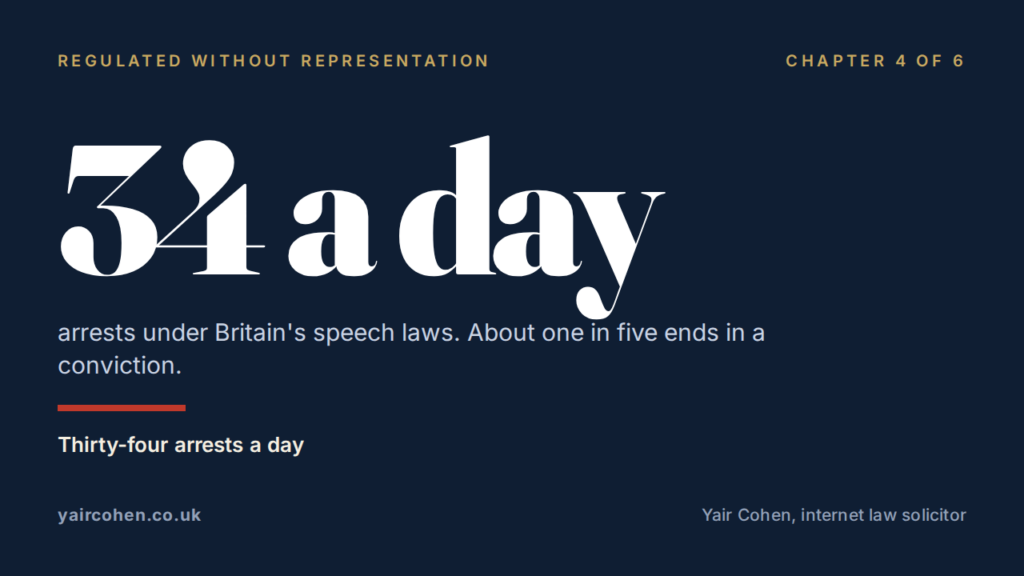
In 2023, 37 of Britain’s police forces made 12,183 arrests under section 127 of the Communications Act and the Malicious Communications Act, the switchboard rule and the letterbox rule from chapter 1. That is about 33 a day, up 58 per cent on 2019. Eight forces did not answer. In the same year only 1,119 people were sentenced under those offences, so fewer than one arrest in ten produced a conviction. Over the five years from 2021 to 2025, according to the campaign group Big Brother Watch, there were 62,199 arrests under speech and communications laws, about 34 a day, of which 18,510 led to a charge and 12,292 to a conviction. Roughly one in five.
Think about what a four in five failure rate means in practice. It means something like ten thousand people a year arrested and never convicted, and in my experience of these cases the arrest is often at home, early in the morning, with a night in a cell and a phone seized, before release with no charge. The arrest is the punishment.
Arrests that ended in apologies or acquittals
Since the riots a pattern has emerged. The high-profile arrests end not in court but, months or years later, in an apology and a cheque.
Graham Linehan is the Irish writer who co-created Father Ted and The IT Crowd, and a loud critic of transgender activism. On 1 September 2025 he stepped off a flight at Heathrow and was met by five armed officers, who arrested him over three posts on X. His bail conditions barred him from using X. No charge followed. The Metropolitan Police apologised in May 2026 and in July was reported to have paid him £25,000.
Allison Pearson is a columnist for the Daily Telegraph. On Remembrance Sunday 2024 police officers came to her door about a tweet from a year earlier, which she had deleted. No charge. In July 2026 the Essex Police and Crime Commissioner, the elected official who oversees that force, apologised to her and paid substantial damages over statements made about her.
Maxie Allen and Rosalind Levine are parents in Hertfordshire. In January 2025 six officers arrested them over messages in a WhatsApp group complaining about their daughter’s school. The force admitted the arrest was unlawful and paid £20,000.
Livia Tossici-Bolt is a retired medical scientist. In April 2025 she was convicted for standing near an abortion clinic in Bournemouth holding a sign that read “Here to talk, if you want”. She received a conditional discharge, which means no penalty unless she offends again, and was ordered to pay £20,000 towards the prosecution’s costs. The US State Department said it was “disappointed”.
Hamit Coskun burned a Quran outside the Turkish consulate in London in February 2025 and was attacked with a knife while doing it. He was prosecuted and convicted. The conviction was overturned, and in February 2026 the High Court confirmed his acquittal, the judge observing that legitimate protest “can be offensive at least to some, and on occasions must be, if it is to have impact”.
Not one of the people in this section went to prison. They were arrested, searched, bailed, prosecuted or fined, and in most cases the state eventually conceded, with an apology or an acquittal, that it need not have acted at all.
The correction that did not touch the law
To be fair to Britain, some of this has been noticed at home. In March 2025 the Crown Prosecution Service, our national prosecutor, rewrote its guidance to say speech cases should only proceed where interference with free expression is “necessary and proportionate”. A week after the Linehan arrest, Sir Mark Rowley said the laws were “tying officers’ hands” and asked Parliament to change them, and in October 2025 the Metropolitan Police announced it would stop investigating non-crime hate incidents. In April 2026 the Home Secretary, Shabana Mahmood, whose department is roughly the interior ministry, abolished “non-crime hate incidents” altogether. These were records, kept against a person’s name, of incidents that were not crimes but were perceived as hateful; there were about 13,000 a year. Her words were that forces “will no longer be policing perfectly legal tweets“.
All of that is welcome. None of it changed a single statute. The police have been told to calm down. The tools are still on the shelf.
The repeal that was promised
Here is the part I find hardest to forgive, because it was not an oversight. It happened in three documents, and you can read all of them.
The first is dated July 2021. The Law Commission, the independent body that advises Parliament on law reform, published a lengthy report on the communications offences. It recommended that section 127(1) of the Communications Act and the Malicious Communications Act “should be replaced with a new offence” based on harm, and it said of the “grossly offensive” standard that “it is not clear exactly what the justification for criminalising grossly offensive communications is”.
The second is dated 4 February 2022. The Government accepted the report. The minister’s written statement to Parliament said, in terms: “The government will repeal the existing communication offences, including section 1 of the Malicious Communications Act 1988 and sections 127(1) and (2) of the Communications Act 2003”.
The third is the Act itself. When the Online Safety Bill emerged from Parliament in October 2023, section 189 repealed only the “false message” parts of the old offences. The “grossly offensive” offence in section 127(1) survived. The “grossly offensive” limb of the Malicious Communications Act survived. The harm-based replacement the Law Commission had designed was never enacted. The Law Commission’s own website now records, with some restraint, that “the majority of the recommended offences were implemented”. The one that mattered most was not.
When the House of Lords asked in July 2025 whether the Government would now repeal section 127, the Home Office minister, Lord Hanson, declined to propose it. A free-market think tank has since published a draft Free Speech Act that would do the job. No Member of Parliament has taken it up.
So the position is this. The Government accepted, in writing, that the 1935 telephone rule should go. It then passed a 303 page Act and left the rule exactly where it was. And it has since been used, alongside the Public Order Act, at a rate of around 34 arrests a day.
My final thoughts
I have spent my career acting for people who are harassed, threatened and defamed online, and I have argued before that the online world should be policed by the same law as the offline one. So I am not asking for less law. I am asking for the right law.
Threats have their own offence. Harassment has its own Act, the Protection from Harassment Act 1997, which I use every month on behalf of clients. Stirring up racial hatred has its own offence, with a seven year maximum, and it is the one that actually put the riot posters in prison. What Britain does not need is a residual crime of being “grossly offensive”, judged by a magistrate without a jury, which produces twelve thousand arrests and eleven hundred convictions a year and functions mainly as a licence to arrest. The Law Commission said so. The Government agreed. Somebody should hold it to its word.
For the serious reader
If you are a US operator: British police send data requests to American platforms on the strength of these offences, and a post that is plainly lawful in Texas can be an offence in Tyneside. When you receive a request, ask which offence is alleged. If the answer is section 127 or the Malicious Communications Act, you are being asked to help enforce a 1935 standard that Britain’s own Law Commission recommended abolishing and the Government promised to repeal.
If you are British: no central record of these arrests is published. Almost every arrest figure you have just read had to be prised out of individual police forces one freedom of information request at a time. Ask your Member of Parliament why.
Next: Chapter 5, Who decides what you read? Imagine Washington ordering Google to put CNN first. Britain is about to do it with the BBC, and my own community would be among the first to lose.
Sources for this chapter
- R v Connolly [2025] EWCA Crim 657: https://www.judiciary.uk/wp-content/uploads/2025/05/Lucy-Connolly-v-The-King.pdf
- ITV News, why Lucy Connolly has been released, 21 August 2025: https://www.itv.com/news/anglia/2025-08-21/why-has-lucy-connolly-been-released-from-prison-now
- NPCC, one year on, 4 August 2025: https://news.npcc.police.uk/releases/one-year-on-police-release-images-of-outstanding-riot-suspects-from-last-summers-disorder
- Press Association sentencing tally (Shields Gazette), August 2025: https://www.shieldsgazette.com/news/violent-disorder-81-year-olds-and-9-year-sentences-the-numbers-behind-the-2024-southport-stabbing-riots-5256730
- Malay Mail, first jail sentences for online posts, 10 August 2024: https://www.malaymail.com/news/world/2024/08/10/uk-issue-first-jail-sentences-for-provocative-online-posts-while-on-high-alert-for-more-racial-riots/146569
- Tell MAMA, three year sentence for X user: https://tellmamauk.org/three-year-prison-sentence-for-x-user-who-incited-racism-online/
- Al Jazeera, Julie Sweeney sentence, 15 August 2024: https://www.aljazeera.com/amp/news/2024/8/15/uk-woman-jailed-for-blow-up-mosque-facebook-post-after-southport-riots
- Fox News, Met Commissioner remarks, August 2024: https://www.foxnews.com/media/uk-police-commissioner-threatens-extradite-jail-us-citizens-over-social-media-posts-we-come-afte
- US State Department, 2024 Country Report on Human Rights Practices, United Kingdom: https://www.state.gov/reports/2024-country-reports-on-human-rights-practices/united-kingdom/
- Free Speech Union, police make 30 arrests a day (The Times FOI): https://freespeechunion.org/archive/police-make-30-arrests-a-day-for-offensive-online-messages
- House of Lords Library, Select communications offences and concerns over free speech: https://lordslibrary.parliament.uk/select-communications-offences-and-concerns-over-free-speech/
- House of Lords, Online Communication Offence Arrests, 17 July 2025: https://hansard.parliament.uk/lords/2025-07-17/debates/F807CB70-D90D-4A19-9433-99539B7CF21F/OnlineCommunicationOffenceArrests
- Free Speech Union on Big Brother Watch, Britain’s Free Speech Problem, September 2026: https://freespeechunion.org/news/more-than-62-000-people-have-been-arrested-for-speech-offences-over
- Free Speech Union, Met Police apologise to Graham Linehan: https://freespeechunion.org/news/met-police-apologise-to-graham-linehan
- Irish Times, Linehan settlement, 10 July 2026: https://www.irishtimes.com/world/uk/2026/07/10/graham-linehan-gets-reported-25000-settlement-from-uk-police-over-arrest-for-x-posts/
- Press Gazette, Allison Pearson damages, 30 July 2026: https://pressgazette.co.uk/news/police-and-crime-commissioner-to-pay-allison-pearson-substantial-damages/
- Doughty Street Chambers, Allen and Levine unlawful arrest claim: https://www.doughtystreet.co.uk/news/parents-succeed-unlawful-arrest-claim-against-police
- CBS News, Livia Tossici-Bolt conviction, April 2025: https://www.cbsnews.com/news/europe-free-speech-uk-abortion-protest-adf-livia-tossici-bolt-convicted-buffer-zone/
- DPP v Coskun, High Court, 27 February 2026: https://www.judiciary.uk/judgments/director-of-public-prosecutions-v-hamit-coskun/
- Malay Mail, London police to stop investigating non-crime posts, 21 October 2025: https://malaymail.com/news/world/2025/10/21/free-speech-wins-london-police-to-stop-investigating-social-media-posts-that-arent-crimes/195359
- College of Policing, major reforms to hate incident recording, 31 March 2026: https://www.college.police.uk/article/major-reforms-police-hate-incident-recording
- Deseret News, UK scraps non-crime hate incidents, 1 April 2026: https://www.deseret.com/politics/2026/04/01/uk-scraps-non-crime-hate-incidents-speech-policing/
- Law Commission, Modernising Communications Offences, Law Com No 399 (2021): https://assets.publishing.service.gov.uk/media/61ba022ad3bf7f05539de6f5/Modernising-Communications-Offences-2021-Law-Com-No-399.pdf
- Law Commission project page, Reform of the communications offences: https://lawcom.gov.uk/project/reform-of-the-communications-offences
- Written Ministerial Statement HCWS590, 4 February 2022: https://questions-statements.parliament.uk/written-statements/detail/2022-02-04/hcws590
- Online Safety Act 2023, section 189: https://www.legislation.gov.uk/ukpga/2023/50/section/189
- Communications Act 2003, section 127: https://www.legislation.gov.uk/ukpga/2003/21/section/127
- Reclaim The Net, Adam Smith Institute Free Speech Act, April 2026: https://reclaimthenet.org/free-speech-act-uk
- Protection from Harassment Act 1997: https://www.legislation.gov.uk/ukpga/1997/40/contents
- Yair Cohen, Keep free speech, stop online harassment, 27 August 2025: https://yaircohen.co.uk/keep-free-speech-stop-online-harassment/