

This is chapter 2 of Regulated Without Representation, a series by internet law solicitor Yair Cohen on how Britain regulates the internet and who pays for it. New here? Start with the introduction. The previous chapter is here.
In the spring of 1765 the British Parliament had a problem that will sound familiar to any finance minister. It had just won a long and expensive war against France, it was keeping an army in North America to hold what it had won, and it wanted somebody else to pay for the army.
The somebody else was the colonists. The Stamp Act, passed on 22 March 1765, required every legal document, newspaper, pamphlet, almanac, playing card and pair of dice in the American colonies to carry an embossed revenue stamp. It was, from London’s point of view, entirely reasonable. The colonies were being defended; the colonies could contribute. The colonies saw it differently. They had not been consulted, they had no members in the Parliament that voted the tax, and their assemblies said so in language that has been on schoolroom walls ever since: no taxation without representation. Delegates from nine colonies met in New York that October to say it together.
The Stamp Act lasted a year. It was repealed on 18 March 1766, and on the same day, to save face, Parliament passed the Declaratory Act, insisting that it retained “full power and authority” to make laws binding the colonies “in all cases whatsoever”.
Two hundred and sixty one years later, we are doing it again. This time the paper is digital and the army is a regulator.
The invoice from Riverside House
Ofcom’s headquarters is a glass block called Riverside House, on the south bank of the Thames by Southwark Bridge. Some time in September 2026, if the regulator kept to its published timetable, its finance team began preparing the first invoices under Part 6 of the Online Safety Act, which requires the providers of certain online services to pay Ofcom an annual fee for the cost of regulating them. Let me explain how the fee works, without the jargon, using an imaginary company.
Suppose you run a social platform from Austin, Texas. You have a few million British users, which puts you within the Act. In 2024, the reference year, your company and the other companies in your group earned, from the parts of your service that carry user content, more than £250 million worldwide. That figure is the threshold, set by the Secretary of State, the British cabinet minister responsible, in November 2025. If less than £10 million of it came from Britain you are exempt. Otherwise, you pay.
What do you pay? Read the word “worldwide” again. The fee is not calculated on what you earn in Britain. It is calculated on your qualifying worldwide revenue, meaning what you earn everywhere from the regulated parts of your service, including money received by other companies in your group. A dollar earned in Ohio counts towards the bill from London.
The fee is that worldwide figure multiplied by a percentage tariff. The tariff is Ofcom’s total online safety costs for the year, divided by the combined worldwide revenue of everyone liable. If Ofcom collects too much or too little, the difference rolls into next year. Ofcom’s indicative figure is 0.02 to 0.03 per cent, and it expects 60 to 80 companies to pay, with a company at the threshold facing something in the region of £50,000 to £75,000 a year. Our imaginary Texan platform can live with that. A company with revenue in the tens of billions is doing rather different arithmetic.
Two more things. If you do not tell Ofcom that you are liable, that is a breach of the Act in its own right. If you do not pay, Ofcom can issue a penalty notice, and the maximum penalty under the Act is the greater of £18 million or 10 per cent of your qualifying worldwide revenue. It can also sue for the fee as a debt. So the fee for being regulated is enforced by the power to fine you for being regulated badly. It is an elegant loop.
And then there is the back bill. The annual fee covers Ofcom’s running costs. Schedule 10 of the Act separately allows Ofcom to charge the same companies “additional fees” to recover the money it spent setting the regime up before the fees began, over a period expected to run for three to five years, starting no earlier than 2027/28. The Commons Public Accounts Committee was told in 2024 that those set-up costs could reach £169 million. The regulations fixing the back bill have not yet been made. The companies are being asked to pay for the years before they were asked, and they do not yet know how much.
The first charging year began on 1 April 2026. More than 40 providers filed the required notification. Ofcom said it would publish the tariff and send the invoices in September.
Who is paying
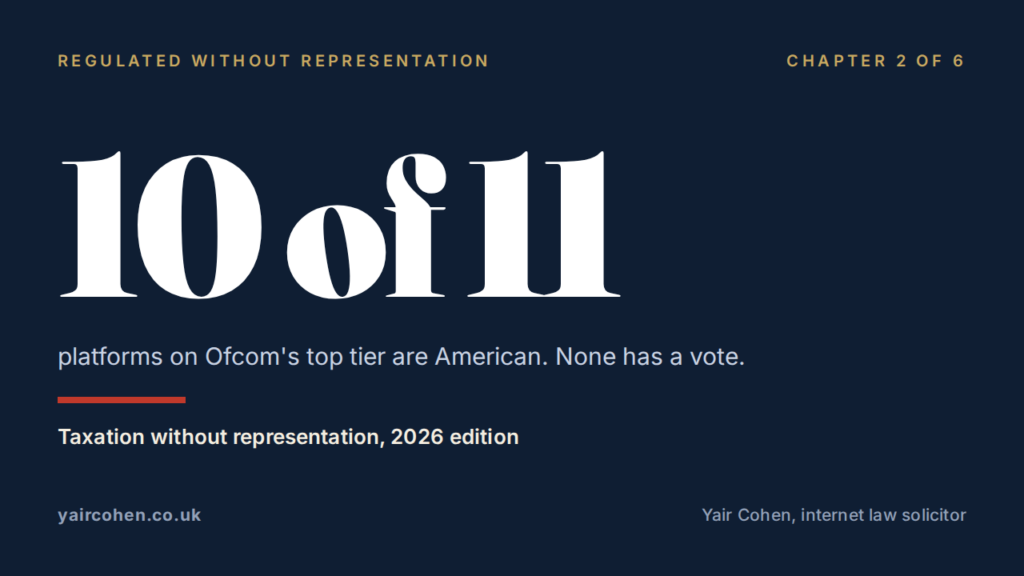
Ofcom has not, so far, published a list of who is paying. But we know who runs the largest services with British users, because Ofcom published that list in July. Of the eleven services in Category 1, the top tier, ten are American: Facebook, Instagram, Pinterest, Quora, Reddit, Roblox, Snapchat, WhatsApp, X and YouTube. The eleventh is TikTok. The search tier is Google, Bing, ChatGPT Search and a search feature within Facebook. Here is the register. Not every fee-payer is in the top tier, and the fee and the register are separate tests, but the shape of the thing is not in doubt. The people paying for Britain’s internet regulator are, overwhelmingly, American companies.
Look at what that has done to Ofcom’s accounts. In its budget for 2025/26 Ofcom planned to raise £69 million from tariffs on the companies it regulates and £158 million from radio spectrum receipts, money collected under the Wireless Telegraphy Act that Ofcom is allowed to keep back from the Treasury. For 2026/27 it expects £164 million from tariffs and only £68 million from spectrum. In Ofcom’s own words, for the first time in many years it will be “funded in the majority by tariff income from the regulated companies” rather than by spectrum receipts. The difference is, almost entirely, the online safety fee. A regulator that grew from 937 staff to 1,665 in six years is, from this year, paid for mostly by the companies it polices.
The genius of it
I want to be fair to the people who designed this, so let me make their case before I explain why I think it is a mistake.
Britain funds several regulators from the industries they regulate. The Financial Conduct Authority is paid for by the firms it regulates. The argument is simple and not silly: the public should not have to pay to police a private industry’s failings. Ofcom put the moral version of the case when it fined 4chan in March: companies, wherever they are based, are not allowed to sell unsafe toys to children in the UK. The analogy is meant to carry across to online services. It is a good line, and it is sincerely meant.
Here is where it breaks. A British bank regulated by the FCA has a licence, a British headquarters, a seat at the table and a vote in the country. The online safety fee is charged to foreign companies, on their foreign revenue, for the cost of a regime they had no part in designing, enforced by the threat of a fine of up to 10 per cent of their qualifying worldwide revenue. It is not called a tax. Had it been, it would have raised awkward questions under Britain’s trade agreements. It is called a fee. The colonists, for their part, were told the stamp duty was a fair contribution to their own defence.
Now consider the incentive the design creates. The tariff is Ofcom’s costs divided among the payers. If Ofcom’s costs rise, the tariff rises. If the payers’ revenues rise, the fee rises. The regulator’s income now grows with the size of the industry it regulates and with the size of its own ambitions, and neither the payers nor, in any practical sense, Parliament sets the figure. I do not suggest bad faith at Ofcom. I suggest that a body funded this way will never find a reason to do less. That is not a criticism of the people. It is a description of the plumbing.
Then remember that these same companies already pay Britain’s Digital Services Tax, a 2 per cent charge on their British revenues from search, social media and marketplaces, which raised £944 million in the last financial year. So the view from Menlo Park or Mountain View is this: a tax on your British revenue, a levy on your worldwide revenue, a back bill for the years before the levy began, and a fine of up to 10 per cent of your qualifying worldwide revenue if you get any of it wrong. And you did not get a vote.
The view from Washington
Washington has noticed. In February 2025 the President signed a memorandum with the unsubtle title “Defending American Companies and Innovators From Overseas Extortion and Unfair Fines and Penalties”. It names the United Kingdom, and it says that where a foreign government imposes “a fine, penalty, tax, or other burden that is discriminatory” on American companies, the administration “will act, imposing tariffs and taking such other responsive actions”. In August this year the United States Trade Representative, Jamieson Greer, accused Britain of using American companies as “piggy banks”. His complaint was about the tax. I doubt the fee will improve his mood when he reads about it.
In 1766 Parliament repealed the Stamp Act not because it was persuaded by the colonists but because British merchants, hurt by the colonial boycott, made more noise than the Treasury could bear. It then passed the Declaratory Act so that nobody could say it had given in. Section 4 of the Online Safety Act, which in Ofcom’s words reaches any service with British users “no matter where in the world it is based“, is our Declaratory Act. Whether the repeal comes first this time, or the boycott, is the subject of chapter 6.
For the serious reader
If your group’s worldwide revenue from the user-content or search parts of your services was £250 million or more in the reference year, and your UK revenue was £10 million or more, you are a fee-payer. The duty to notify Ofcom is legally enforceable in its own right. The notification window for the 2027/28 charging year closes on 30 September 2026; each year’s deadline falls at least six months before the charging year begins. The declaration has to be signed by a senior manager.
If you are below the threshold, you pay nothing, but every other duty in the Act still applies to you. Chapter 3 explains how far those duties reach.
If you are British: you are not paying for this regulator. Neither, in the end, are the platforms. Their British users and advertisers are, in the price of what they buy.
Next: Chapter 3, The hamster, the judge and the regulator. How the regulator serves formal notices on American businesses by email, what happened when 4chan replied with a picture of a hamster, and why a federal judge in Washington decided in September 2026 that Ofcom could not be sued in this way.
Sources for this chapter
- UK Parliament, The Stamp Act and the American colonies 1763 to 1767: https://www.parliament.uk/about/living-heritage/evolutionofparliament/legislativescrutiny/parliament-and-empire/parliament-and-the-american-colonies-before-1765/the-stamp-act-and-the-american-colonies-1763-67/
- Declaratory Act 1766, text (Yale Avalon Project): https://avalon.law.yale.edu/18th_century/declaratory_act_1766.asp
- Library of Congress, No Taxation Without Representation: https://loc.gov/exhibits/magna-carta-muse-and-mentor/no-taxation-without-representation.html
- Online Safety Act 2023, section 83 (duty to notify): https://www.legislation.gov.uk/ukpga/2023/50/section/83
- Online Safety Act 2023, section 84 (duty to pay fees): https://www.legislation.gov.uk/ukpga/2023/50/section/84
- Online Safety Act 2023, section 141 (non-payment of fee): https://www.legislation.gov.uk/ukpga/2023/50/section/141
- Online Safety Act 2023, Schedule 10 (recovery of Ofcom’s initial costs): https://www.legislation.gov.uk/ukpga/2023/50/schedule/10
- Online Safety Act 2023, Schedule 13 (penalties): https://www.legislation.gov.uk/ukpga/2023/50/schedule/13
- Online Safety Act 2023 (Fees) (Threshold Figure) Regulations 2025, SI 2025/1204: https://www.legislation.gov.uk/uksi/2025/1204/made
- Online Safety Act 2023 (Qualifying Worldwide Revenue) Regulations 2025, SI 2025/1032: https://www.legislation.gov.uk/uksi/2025/1032/made
- Online Safety Act 2023 (Fees Notification) Regulations 2025, SI 2025/747: https://www.legislation.gov.uk/uksi/2025/747/made
- Ofcom, Online safety fees and penalties (updated 26 August 2026): https://www.ofcom.org.uk/online-safety/illegal-and-harmful-content/online-safety-fees-and-penalties
- Ofcom, Guidance on qualifying worldwide revenue: https://www.ofcom.org.uk/online-safety/illegal-and-harmful-content/guidance-on-qualifying-worldwide-revenue-online-safety-fees-and-penalties
- Ofcom, Statement on online safety fees and penalties (26 June 2025): https://www.ofcom.org.uk/siteassets/resources/documents/consultations/category-1-10-weeks/consultation-online-safety—fees-and-penalties/main-documents/statement-on-online-safety-fees-and-penalties.pdf
- Ofcom, Statement of Charging Principles (17 March 2026): https://www.ofcom.org.uk/siteassets/resources/documents/consultations/category-1-10-weeks/statement-of-charging-principles-os-fees/main-documents/statement/statement-statement-of-charging-principles-online-safety-fees.pdf
- Ofcom, Statement in response to consultation on the Statement of Charging Principles (17 March 2026): https://www.ofcom.org.uk/siteassets/resources/documents/consultations/category-1-10-weeks/statement-of-charging-principles-os-fees/main-documents/statement/statement-in-response-to-consultation-statement-of-charging-principles-online-safety-fees.pdf
- Ofcom, Notice of the initial charging year (20 November 2025): https://www.ofcom.org.uk/siteassets/resources/documents/consultations/category-1-10-weeks/statement-of-charging-principles-os-fees/main-documents/notice-of-2026-charging-year.pdf
- Ofcom, Notification guidance: https://www.ofcom.org.uk/siteassets/resources/documents/consultations/category-1-10-weeks/statement-of-charging-principles-os-fees/main-documents/os-fees-and-penalties-notification-guidance.pdf
- Ofcom, Online safety industry bulletin, June 2026: https://www.ofcom.org.uk/online-safety/illegal-and-harmful-content/online-safety-industry-bulletins/online-safety-industry-bulletin-june-2026
- Ofcom, Register of categorised services (10 July 2026): https://www.ofcom.org.uk/online-safety/illegal-and-harmful-content/register-of-categorised-services-and-list-emerging-category-1-services
- Ofcom, Tariff Tables 2026/27: https://www.ofcom.org.uk/siteassets/resources/documents/about-ofcom/how-ofcom-is-run/annual-reports/plans-and-financial-reporting/tariff-tables/ofcom-tariff-tables-2026-27.pdf
- Ofcom Annual Report and Accounts 2019/20: https://assets.publishing.service.gov.uk/media/5f184d3f3a6f407274d891d9/ofcom-annual-report-and-accounts-2019-20.pdf
- Ofcom Annual Report and Accounts 2025/26: https://assets.publishing.service.gov.uk/media/6a4e92bb43f694ee291df854/Ofcom_Annual_Report_and_Accounts_2025-2026_optimised_A.pdf
- Public Accounts Committee, Preparedness for online safety regulation (21 February 2024): https://publications.parliament.uk/pa/cm5804/cmselect/cmpubacc/73/report.html
- Ofcom, 4chan fined (19 March 2026): https://www.ofcom.org.uk/online-safety/illegal-and-harmful-content/4chan-fined-450000-for-not-protecting-children-from-online-pornography
- Telecoms.com, US internet forums sue Ofcom (Ofcom quotation on links with the UK), August 2025: https://www.telecoms.com/regulation/us-internet-forums-sue-ofcom-over-online-safety-act
- HMRC, Tax and NICs receipts (Digital Services Tax table, August 2026): https://assets.publishing.service.gov.uk/media/6a82f19d3be22055c1aaa3ba/NS_Table.ods and https://www.gov.uk/government/statistics/hmrc-tax-and-nics-receipts-for-the-uk
- White House, Presidential memorandum, 21 February 2025: https://www.whitehouse.gov/presidential-actions/2025/02/defending-american-companies-and-innovators-from-overseas-extortion-and-unfair-fines-and-penalties/
- Time, UK responds to mounting Trump pressure over Digital Services Tax (19 August 2026): https://time.com/article/2026/08/19/uk-responds-to-mounting-trump-pressure-over-digital-services-tax/