

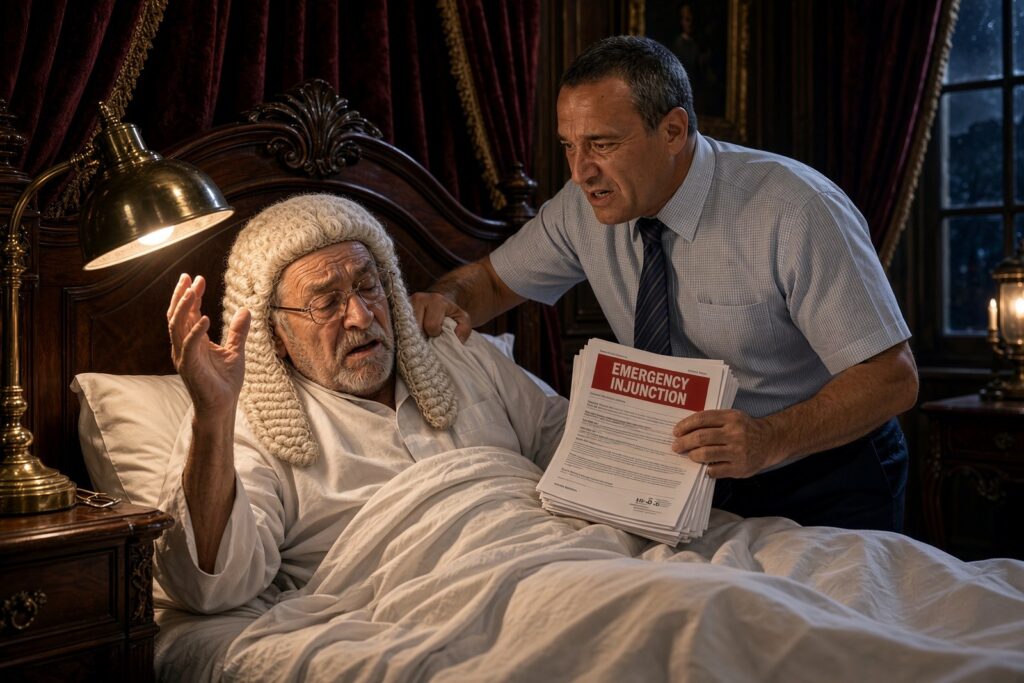
An emergency injunction served two hours before the disclosure deadline
Case summary
Not every blackmailer is a stranger behind a fake profile. My client, a married American businessman known in these proceedings as PHJ, had a relationship over two years with someone inside his wider personal circle. When it ended she remained close to his family life, and the financial help he had given her while they were together slowly changed character: first expected, then insisted upon, then demanded. Over several years he paid her more than £37,000.
When he finally tried to stop, the threats began. She would tell his wife, his family and his business contacts about the relationship; she would show them the private messages and the payment records. The last demand was for a further £20,000, to be paid by ten o’clock that night. Under that pressure he paid just over £5,000. He did not believe it would end anything. He paid to buy the time needed to get a court order in place, and that, with advice, is the only sensible reason ever to make such a payment.
He instructed me on 6 July 2026. Two days later, shortly after 1pm on 8 July, we filed the application: a witness statement, the exhibits, a draft order and a skeleton argument, prepared in 48 hours and complete enough to satisfy the duty of full and frank disclosure that a without notice application carries. The court accepted it at about 3pm. Mrs Justice Thornton heard it that afternoon, without notice to the defendant. We served the injunction on her at 7.51pm, a little over two hours before her own deadline. From first instruction to a served High Court order took about 48 hours. The threatened exposure never happened.
What the court decided
The order of 8 July 2026 is on the judiciary’s website. The judge was satisfied under section 12(2) of the Human Rights Act 1998 that there were compelling reasons for not giving notice: the threat of imminent publication, coupled with the demands for money. She forbade the defendant from using, publishing or disclosing the information, from identifying the claimant as a party or as the subject of it, and from contacting him, his family or anyone associated with him, with a sensible carve-out that allowed her to go to the police if she wished. Within 24 hours of service she had to disclose whether she had already passed the information to anyone, and if so to whom and when, and to confirm that in a witness statement within seven days. A reporting restriction under section 4(2) of the Contempt of Court Act 1981 ran until noon the next day, when the order was published.
The unusual feature of this order is that both parties were anonymised. The claimant is PHJ, which is the ordinary protection for a blackmail victim, since naming him would hand the blackmailer exactly what the injunction exists to prevent. The defendant is UJV, which is rarer. The court accepted, under section 6 of the Human Rights Act and CPR 39.2, that naming her would risk jigsaw identification: she was close enough to my client’s family circle that anyone who knew her could have worked out who he was and what the case was about. Her last known address went to the court in a sealed letter. Anonymity on both sides was the only way to make the protection real.
Case outcome
The return date was fixed for 16 July. In response to the application the defendant made allegations of her own, which my client denies and which the court has not determined; at the interim stage the court’s task was to hold the position before any disclosure could do irreversible harm, not to decide between competing accounts. The parties agreed to move the return date to 23 July 2026 so that she could take advice, and the injunction stayed in force throughout.
On 23 July 2026 Mrs Justice Tipples, sitting in the Media and Communications List, continued the injunction until trial or further order. The hearing was on notice to the defendant; she did not attend and was not represented, and the court was satisfied that it was right to proceed without her. The anonymity of both parties was continued, and the defendant was ordered to disclose the identity of anyone to whom she had passed the information and to confirm what she had disclosed in a witness statement verified by a statement of truth. My client is protected through to trial.
Lawyers’ thoughts about the case
Blackmail does not need a fake profile or compromising images. It can grow out of a real relationship one payment at a time, until the refusal to pay becomes the trigger for threats, and the law treats it exactly as it treats the anonymous sextortionist: the High Court will stop the disclosure, protect the victim’s name and act within days.
Cases like this hang in the balance in a way few others do. If the order arrives in time, nothing happens: the information stays where it is, the family is untouched, and the client gets his life back. If it arrives late, the harm lands all at once and cannot be undone. That is the weight a legal team carries through those 48 hours, and it is why calm matters more than drama. A man handing the worst problem of his life to solicitors in another country, whom he met two days earlier, needs to see competence, not urgency passed back to him.
Speed is not the skill. The skill is preparation at speed. A without notice application that fails does not leave you where you started: the other side learns you went to court, the papers have to be served on her, and the protection becomes harder to get. So the application has to deserve to succeed the first time, because in practice the first time is the one that counts. Whether to make the payment that buys the time, what goes into the witness statement, who is told what and when: each of those decisions looks small in the moment and each can change the outcome. The injunction is the visible result. The judgement behind it is where the value sits.
Learn more about the case
- The order of Thornton J, 8 July 2026, on the judiciary website: https://www.judiciary.uk/judgments/phj-v-ujv-injunction-with-anonymity-and-reporting-restrictions-orders/
- Cohen Davis case report, PHJ v UJV: https://internetlawcentre.co.uk/phj-v-ujv
- Related cases: The case of XLD v KZL, the blackmail injunction for a US citizen; The case of RXE v Daniel Ryan and others, the injunction that was ready before the blackmailers came back.
- Practice Guidance on interim non-disclosure orders (Master of the Rolls, 2011): https://www.judiciary.uk/wp-content/uploads/JCO/Documents/Guidance/practice-guidance-civil-non-disclosure-orders-july2011.pdf
Both parties are anonymised by order of the High Court. The injunction is interim, continued until trial; the defendant’s allegations are denied and have not been determined.